Sustainabite Journal
Greenhouse vs. container farm in Canada: which fits your growing project?
On this page
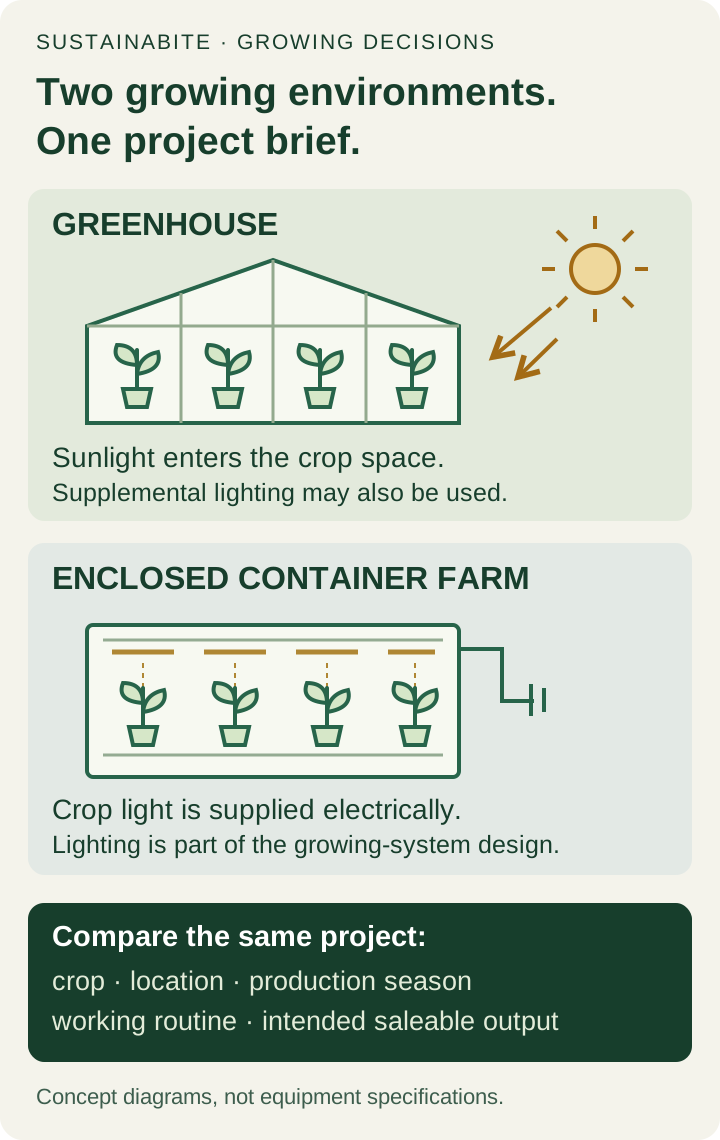
A greenhouse and a container farm can both provide a controlled growing environment. The useful choice starts with how you want to grow: a greenhouse brings sunlight into the crop space, while a fully enclosed container farm supplies its crop light electrically. Your crop, location and selling season determine what you need from that environment.
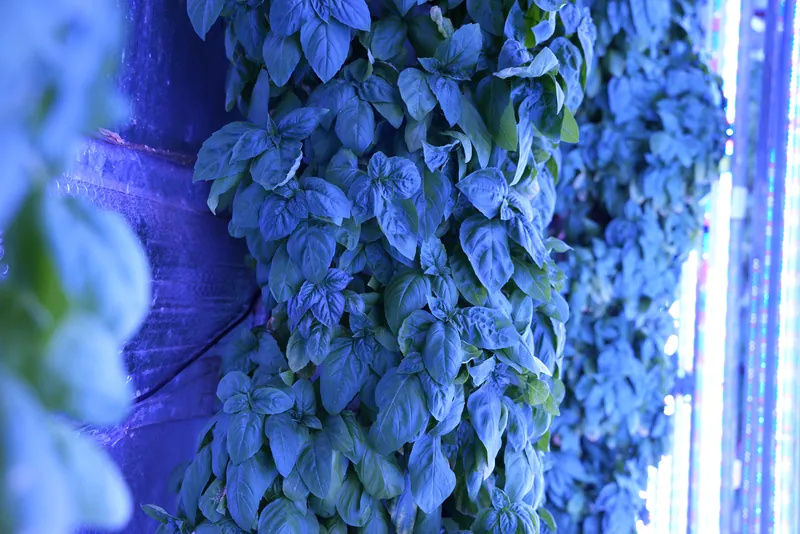
At Sustainabite in Surrey, BC, we grow basil year-round indoors and supply grocery stores. Growing, harvesting, packing and delivery are connected parts of our operation. That experience shapes how we help prospective growers compare a system with the work and customers it needs to support.
If you are choosing between a greenhouse and a container farm in Canada, compare two proposals for the same project. Start with the crop and product you want to sell, the months you want to supply it and the space available. Then examine where each approach fits.
Start with the light, then the growing system
A greenhouse uses a light-transmitting structure to admit daylight. Many greenhouse operations also use supplemental lighting. A fully enclosed indoor farm relies on artificial lighting for crop growth. This distinction is described in the USDA's review of controlled-environment agriculture.
Here, a container farm means an enclosed, artificially lit growing unit. Its lighting can be planned around the crop and production schedule. A greenhouse design works with the sunlight available at the site, alongside any supplemental lighting specified for the project.
Hydroponics is a separate choice: it describes the growing method, rather than the building. A greenhouse can use hydroponics too. Compare the proposed irrigation, plant support and growing layout instead of assuming that the word “hydroponic” identifies one type of farm.
Match the season to the location
Are you extending a local growing season, or supplying customers through winter as well? Put that answer in the brief before comparing equipment.
Greenhouse planning involves the production season, solar access, water, utilities, drainage and space for future development. Those are among the considerations in UMass Extension's commercial greenhouse planning guide.
For a Canadian site, ask each supplier how its proposed heating, cooling, ventilation and lighting support the crop through the months you intend to operate. Use the actual location and specified design. A seasonal greenhouse and a greenhouse equipped for year-round production are different comparisons.
Our year-round basil operation gives us practical experience of maintaining an indoor crop and a grocery-supply routine through the seasons. We use that experience to help you assess the conditions your proposed farm needs.
If you are still deciding what a site can support, our land and space consulting provides a relevant starting point.
Fit the crop and the people into the layout
A building's floor area does not show how comfortably a crop can grow or how easily a person can harvest it. Compare the mature plant size, growing positions, root space, access and harvest method in the actual layout.
For a tall or supported crop, ask to see how the design accommodates the canopy and the person working around it. For compact herbs or leafy greens, examine how the proposed growing positions connect to crop care and harvest access. The useful evidence is a suitable design and demonstrated crop performance in that growing method.
Virginia Cooperative Extension's hydroponic guidance illustrates why system detail matters: crop and variety selection for nutrient film technique should account for market needs, growth habit and maturity.
For Sustainabite's basil business, the finished product is also part of the layout question. We need to grow the crop, harvest it, pack it and supply grocery customers. In your proposal, follow one harvest through those steps. Identify where each job happens and whether people, supplies and finished product can move through the space sensibly.
Compare the working farm, not only its growing room
A greenhouse proposal may include different amounts of working and storage space from a container proposal. Check where propagation, cleaning, packing, supplies and dispatch will take place. Make any separate space part of the comparison.
For a greenhouse, assess the proposed footprint and solar access. For a container, assess delivery, placement and service access. Both need suitable utilities and a check of the permissions and local requirements for the exact site.
These questions help you compare two workable proposals. Our container-farm feasibility checklist covers the fuller site, people and business preparation once you have narrowed the approach.
Ask what drives energy use and daily work
Sunlight contributes to a greenhouse's crop lighting; an enclosed container supplies that light electrically. Those facts alone do not establish which proposed farm has the lower total energy bill. Ask for the assumptions behind heating, cooling, lighting and other equipment for your location and operating season.
Compare the same crop and intended saleable output. A figure for the building, a figure per plant and a figure per kilogram answer different questions. Ask what is included and how the estimate was developed before using it to choose between proposals.
Do the same for labour. Walk through crop care, cleaning, harvest, packing and delivery, and ask which tasks the proposed equipment supports.
For a concrete view of recurring categories, see our monthly operating-cost illustration. It shows our operating-farm example with owner-operated and hired-labour views. Use a separate project estimate to compare your greenhouse and container options.
Which option belongs on your shortlist?
A greenhouse is worth exploring when your plan can make good use of the site's sunlight and you want a structure and layout suited to your crop, production season and future growing area. Specify the environmental equipment needed for the months you intend to supply.
A container farm is worth exploring when you want to evaluate a compact, enclosed production unit with a defined growing layout and lighting system. Check that its crop capacity, working access and supporting spaces fit the product you plan to supply.
For either option, ask what the next expansion would involve. More crop space also needs an operating plan for utilities, people, packing and sales. Comparing that next step makes the initial choice more useful than judging the structures in isolation.
Bring the same brief to both conversations
Give each supplier the same five starting points:
- Crop and product: what you want to grow and how it will be supplied.
- Customer and season: who will buy or use it, and during which months.
- Location and space: the site, available utilities and any existing working areas.
- People and routine: who will grow, harvest, pack and distribute the crop.
- Next step: the scale you want to start at and what a successful expansion would require.
You do not need every answer before starting a conversation. A clear brief helps identify which approach deserves a closer look and what still needs to be worked out.
Sustainabite offers container systems and paid consulting informed by our operating farm. Explore our container farms or discuss your growing project. Tell us your crop, location and where you are in the process. Consulting scope and fees are agreed by quote.